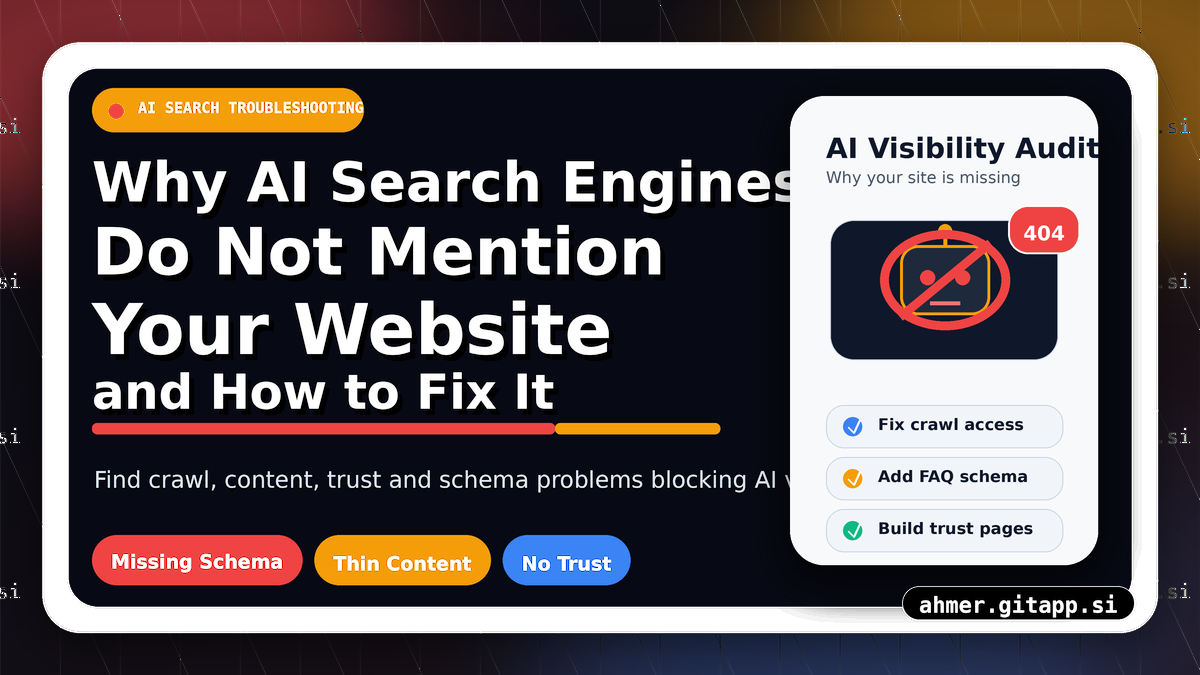
Why AI Search Engines Do Not Mention Your Website and How to Fix It
AI search engines may not mention your website if they cannot clearly understand, trust, access, or verify your content. Tools like ChatGPT, Google AI Overviews, Perplexity, Gemini, and other AI answer engines usually prefer pages that are useful, structured, crawlable, updated, and supported by strong trust signals.
Table of Contents
🤖 Main Reasons AI Search Engines Ignore a Website.
AI search engines do not mention every website they find. They choose sources that look helpful, reliable, and easy to use inside an answer. If your website has thin content, unclear headings, no schema, weak internal links, or missing trust pages, AI systems may choose another source instead.
Another reason is lack of topical authority. If your website has only one short post on a subject while competitors have detailed guides, FAQs, examples, and comparison pages, AI tools may trust competitors more. AI visibility improves when your site covers a topic deeply from multiple angles.
| Reason | What It Means | Quick Fix |
|---|---|---|
| Thin content. | The page does not fully answer the topic. | Add examples, FAQs, tables, steps, and original explanations. |
| No trust signals. | AI cannot easily verify who is behind the website. | Add About, Contact, Privacy, Disclaimer, and Terms pages. |
| Weak structure. | The page is difficult to scan and summarize. | Use clear H2 headings, short paragraphs, lists, and tables. |
| No schema markup. | Search systems get less structured context. | Add Article, FAQ, Organization, and Breadcrumb schema. |
🕷️ Crawl Access and Indexing Problems.
If AI-related crawlers and search engines cannot access your page, your website may not appear in AI answers. Crawl problems can happen because of robots.txt blocks, noindex tags, broken links, server errors, slow loading pages, or missing sitemap.xml.
Start by checking whether your important pages are indexable. Your robots.txt should not accidentally block important content. Your sitemap should include posts and pages you want discovered. Your canonical URL should point to the correct version of the page.
| Technical Check | Good Status | Why It Matters |
|---|---|---|
| robots.txt. | Allows important crawlers. | Blocked pages may not be discovered. |
| Sitemap.xml. | Lists important URLs. | Helps search systems find your content faster. |
| Canonical tag. | Points to the preferred URL. | Reduces duplicate URL confusion. |
| Noindex tag. | Not used on ranking pages. | Noindex can remove a page from search discovery. |
📝 Weak Content Quality and Topic Gaps.
AI search engines need strong content to build useful answers. If your page only gives a basic definition and repeats the same points, it may not be valuable enough to mention. A good page should answer the main question, explain why it matters, show examples, compare options, and solve real user problems.
Topic gaps also reduce AI visibility. For example, if your website talks about AI visibility but does not explain AI citations, AEO, GEO, schema markup, crawlability, and prompt tracking, AI systems may not see your website as a complete source on the topic.
🛡️ Missing Entity and Trust Signals.
AI systems try to understand who created the content and whether the source is reliable. If your website has no clear author, no About page, no Contact page, and no policy pages, it may look less trustworthy than competitors.
Trust signals do not guarantee AI mentions, but they help build confidence. A small website can still improve its trust by clearly showing who owns the site, what the site does, how users can contact the owner, and how user data is handled.
| Trust Signal | Purpose |
|---|---|
| About the Author. | Shows who is responsible for the content. |
| Contact page. | Shows that users can reach the website owner. |
| Privacy Policy. | Explains how user data is handled. |
| Terms and Disclaimer. | Explains limits, rules, and responsibility. |
| Updated dates. | Shows freshness and content maintenance. |
🧩 Schema Markup and Structured Data Issues.
Schema markup helps search engines and AI systems understand the meaning of your page. Without schema, your content may still be readable, but structured context becomes weaker. Schema can identify your article, author, organization, breadcrumb path, and FAQ answers.
For AI visibility, the most useful schema types are Article schema, FAQPage schema, Organization schema, Person schema, and BreadcrumbList schema. These help connect your content with your website identity.
| Schema Type | Best For | Priority |
|---|---|---|
| Article schema. | Blog posts and guides. | High. |
| FAQPage schema. | FAQ sections with visible questions and answers. | High. |
| Organization schema. | Website or brand identity. | High. |
| Person schema. | Author identity. | Medium. |
| BreadcrumbList schema. | Page hierarchy. | Medium. |
💬 Poor AI Answer Format.
AI tools work best with content that is easy to extract. A page with long paragraphs, unclear headings, no direct answers, and no FAQ section may be harder to use in an AI-generated response.
To make your page AI-friendly, start sections with a direct answer. Then explain details in short paragraphs. Use tables for comparisons and checklists. Use FAQs for natural question-based searches. This format helps users and AI systems at the same time.
| Bad Format | Better Format |
|---|---|
| Long paragraph with many ideas. | Short paragraph focused on one answer. |
| Generic heading. | Question-based or descriptive heading. |
| No examples. | Practical examples and use cases. |
| No structure. | Tables, lists, steps, and FAQs. |
✅ Step-by-Step Fix Plan.
If AI search engines do not mention your website, do not fix everything randomly. Use a clear process. First make the page accessible, then improve content depth, then add trust and schema signals.
| Step | Action | Expected Benefit |
|---|---|---|
| Step 1. | Check robots.txt, sitemap.xml, canonical, and noindex. | Improves crawlability and discovery. |
| Step 2. | Rewrite thin pages with deeper answers and examples. | Improves usefulness and topical relevance. |
| Step 3. | Add FAQ sections based on real user questions. | Improves AEO and conversational search coverage. |
| Step 4. | Add Article, FAQ, Organization, Person, and Breadcrumb schema. | Improves structured understanding. |
| Step 5. | Add About, Contact, Privacy, Disclaimer, and Terms pages. | Improves trust and transparency. |
| Step 6. | Create related posts and link them together. | Builds topic authority around AI visibility. |
📌 Practical Example.
Suppose your website has a tool called AI Visibility Checker. If the tool page only says “check AI visibility for free,” AI systems may not have enough context. But if the page explains what AI visibility means, how the score is calculated, what schema is checked, what robots.txt means, and how users can fix problems, the page becomes more useful and more citation-ready.
This is the difference between a simple tool page and a trusted resource. AI search engines are more likely to mention content that explains the topic clearly and helps users solve the problem completely.
📚 Read Also.
Recommended Articles
- What Is AI Visibility and Why Does It Matter for SEO in 2026? Slug: what-is-ai-visibility-and-why-does-it-matter-for-seo-in-2026.
- How to Check If Your Website Appears in ChatGPT, Google AI Overviews and Perplexity. Slug: how-to-check-if-your-website-appears-in-chatgpt-google-ai-ov.
- AEO vs GEO vs SEO: What Is the Difference and Which One Should You Focus On? Slug: aeo-vs-geo-vs-seo-what-is-the-difference-and-which-one-shoul.
- How to Improve Your Website’s AI Visibility Score with Schema, FAQs and Trust Signals. Slug: how-to-improve-your-website-s-ai-visibility-score-with-schem.
- AI Citations Explained: How to Get Your Website Cited by ChatGPT, Perplexity and Google AI Overviews. Slug: ai-citations-explained-how-to-get-your-website-cited-by-chat.
🏁 Final Thoughts.
AI search engines may not mention your website because of weak crawlability, thin content, missing schema, poor answer format, low trust, or limited topic authority. The fix is not keyword stuffing. The fix is to make your website clearer, more useful, more structured, and more trustworthy.
If you want better AI visibility, build pages that answer real questions, show clear expertise, include schema markup, provide trust pages, and connect related articles with internal links. A website that helps users properly has a better chance of being understood, cited, and recommended by AI search systems.
❓ Frequently Asked Questions.
Why does ChatGPT not mention my website?
ChatGPT may not mention your website if your content is not well-known, not clear, not crawlable, not trusted, or not useful enough compared with other sources.
Why does Google AI Overview not show my website?
Google AI Overview may not show your website if competitors have stronger content, better structure, more authority, clearer answers, or better trust signals.
Can robots.txt affect AI visibility?
Yes. If robots.txt blocks important crawlers or your page has a noindex tag, search and AI systems may not discover or use your content properly.
Does schema markup guarantee AI mentions?
No. Schema markup does not guarantee AI mentions, but it helps search engines and AI systems understand your content, author, website identity, FAQs, and page structure.
How can I make my website more AI-friendly?
Use direct answers, clear headings, short paragraphs, tables, FAQs, schema markup, internal links, updated content, and visible trust pages.
What is the fastest way to improve AI visibility?
The fastest way is to fix crawlability issues, improve thin pages, add FAQ sections, include schema markup, and create strong About, Contact, Privacy, Disclaimer, and Terms pages.

I am Kashi Ahmer, founder of Ahmer.gitapp.si. I share simple guides and tools about AI Visibility Checker, SEO, AEO, GEO, schema markup, AI citations, and AI search optimization to help users improve their website visibility in search engines and AI platforms. For feedback or questions, contact me at ahmer@gitapp.si.
Related Posts
 ChatGPT Free Online Guide: Login, App, Download, Search and Safe Use
 What is an agentic browser and how does it work?
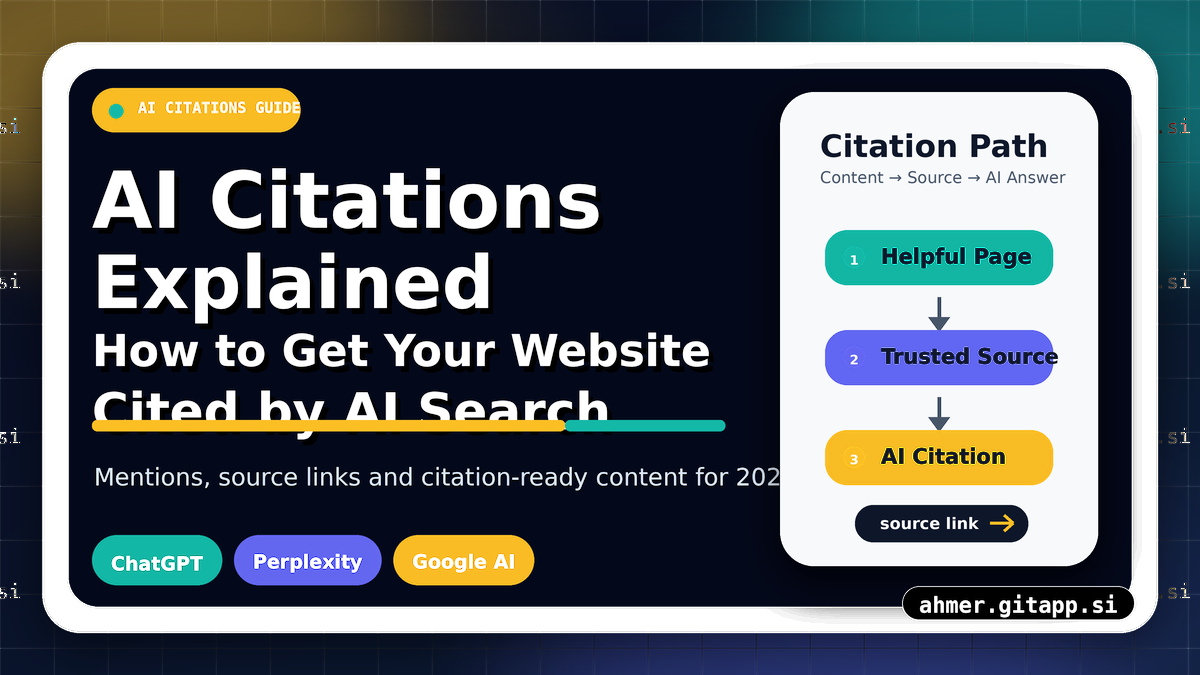 AI Citations Explained: How to Get Your Website Cited by ChatGPT, Perplexity and Google AI Overviews.
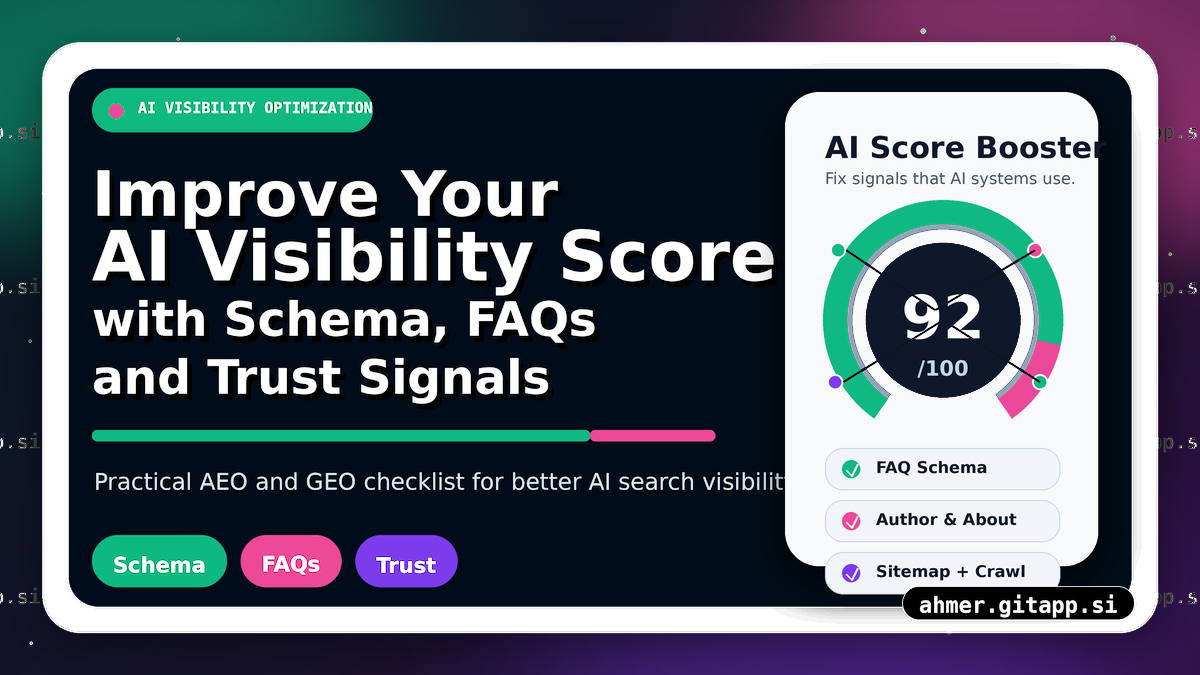 How to Improve Your Website’s AI Visibility Score with Schema, FAQs and Trust Signals
Leave a Comment
No comments yet — be the first to comment!