
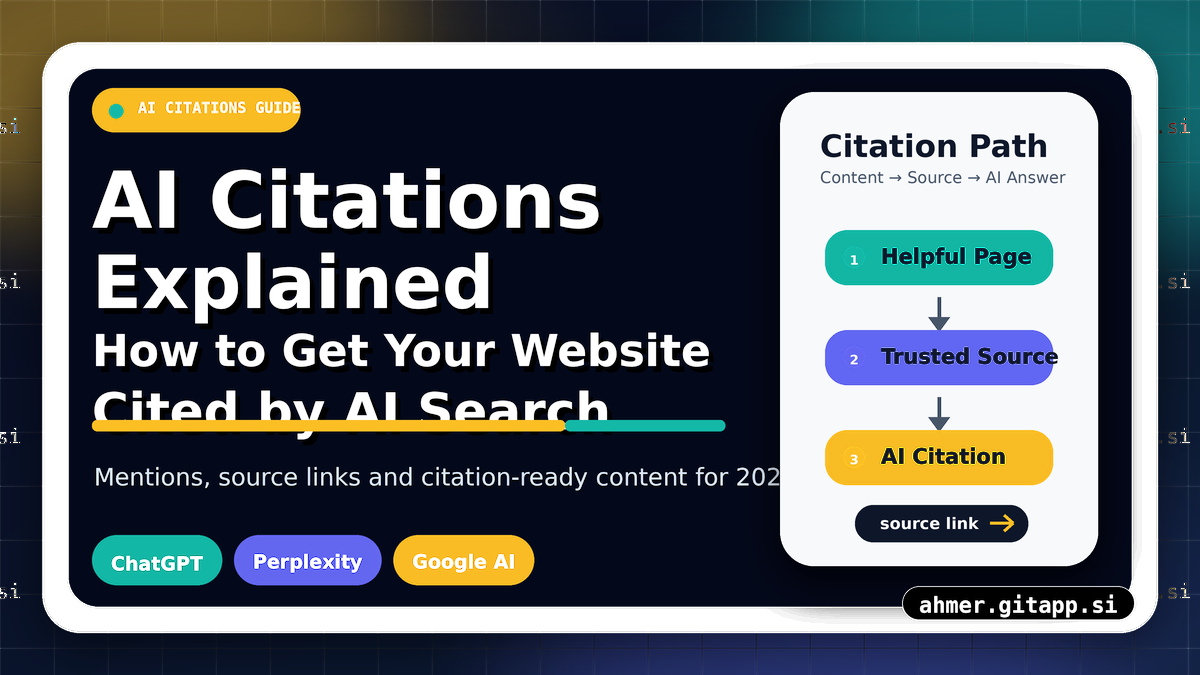
AI Citations Explained: How to Get Your Website Cited by ChatGPT, Perplexity and Google AI Overviews.
AI citations are source references that AI search tools use when they mention, summarize, or recommend information from a website. In simple words, when platforms like ChatGPT, Perplexity, or Google AI Overviews use your page as a source, your website gains AI citation visibility.
Table of Contents
🔗 What Are AI Citations?
AI citations happen when an AI search platform connects an answer with a source page. This can appear as a clickable source link, a cited website, a reference card, or a visible source name inside the answer.
For website owners, AI citations are valuable because they can build trust before the user even visits the website. If an AI tool uses your content as a source, it means your page is being treated as useful for that query.
Simple example: If a user asks “What is an AI visibility checker?” and an AI platform shows your website as a source, that is an AI citation.
📌 AI Mention vs AI Citation vs Source Link.
Many people confuse AI mentions and AI citations, but they are not exactly the same. A brand mention means the AI answer names your website or brand. A citation means the AI answer uses your page as a source. A source link is the strongest form because it may send visitors directly to your website.
| Signal | Meaning | SEO Value |
|---|---|---|
| AI Mention | Your brand or website name appears in an AI answer. | Good for awareness and brand recognition. |
| AI Citation | Your page is used as a supporting source for an AI answer. | Strong for authority and trust. |
| Source Link | Your website link appears as a clickable source. | Best for referral traffic and credibility. |
| Recommendation | AI suggests your tool, product, service, or guide. | Powerful for leads, conversions, and brand demand. |
🧠 How AI Search Engines Choose Sources.
AI search engines usually choose sources that are useful, clear, current, crawlable, and trusted. A page that explains one topic deeply is more likely to be used than a page that only repeats basic information.
AI systems may compare multiple sources before creating an answer. They often prefer pages that include definitions, examples, data, step-by-step explanations, comparison tables, FAQs, and clear author or website information.
This is why AI citation strategy is not only about keywords. It is about building pages that AI tools can confidently use as a source.
🧱 What Makes Content Citation-Ready?
Citation-ready content is content that can be easily understood, quoted, summarized, and trusted by AI systems. It should answer the main question clearly and then support that answer with proof, examples, and structure.
| Content Element | Why It Helps AI Citations | Practical Example |
|---|---|---|
| Direct answer block. | AI can quickly understand the main point. | Start a section with “AI citations are source references used by AI search tools.”. |
| Original explanation. | Unique wording gives AI a reason to use your page. | Explain your own framework, checklist, or method. |
| Comparison table. | AI can extract differences clearly. | Compare AI mention, AI citation, and source link. |
| FAQ section. | Matches real user questions in AI tools. | Add questions about citations, Perplexity sources, and Google AI Overviews. |
| Trust details. | AI systems need confidence in the source. | Add author, update date, contact page, privacy policy, and about page. |
✅ The Citation-First Page Formula.
A strong citation-ready page should not start with fluff. It should start with a clear answer, then explain the topic in layers. This makes the page useful for users and easier for AI systems to extract.
| Page Section | Purpose | Best Practice |
|---|---|---|
| Short definition. | Gives AI a clean answer. | Use the main keyword in the first sentence naturally. |
| Reason or benefit. | Explains why the topic matters. | Connect the topic with user problems and search intent. |
| Evidence section. | Builds confidence. | Add examples, comparisons, steps, or original observations. |
| Structured table. | Makes extraction easier. | Use tables for differences, checklists, and processes. |
| FAQ block. | Targets conversational AI prompts. | Answer common questions clearly and briefly. |
🗺️ AI Citation Strategy Map.
To increase your chances of getting AI citations, create content for different prompt types. AI tools answer different kinds of questions, so your website should cover definitions, comparisons, problems, tools, and step-by-step guides.
| Prompt Type | Example User Prompt | Best Content Asset |
|---|---|---|
| Definition prompt. | What are AI citations? | A clear beginner guide with examples. |
| Comparison prompt. | AI citations vs AI mentions. | A comparison table and use-case breakdown. |
| Problem prompt. | Why is my website not cited by AI? | A troubleshooting guide with fixes. |
| Tool prompt. | Best AI visibility checker tools. | A tool page with features, score method, and FAQs. |
| Process prompt. | How to improve AI citations? | A step-by-step checklist with schema and content advice. |
⚠️ Why Your Website May Not Get AI Citations.
Your website may not get AI citations if your content is too generic, too short, or too similar to other websites. AI tools do not need another page that says the same thing in a weaker way.
Other common issues include blocked crawling, missing sitemap, no structured data, poor headings, hidden content, no trust pages, outdated information, and pages that do not answer a specific question.
Important: AI citation optimization is not about keyword stuffing. It is about making your page useful enough to become a reliable source.
📊 How to Track AI Citations.
AI citations can change over time, so tracking is important. You should test the same prompts regularly and record whether your website is mentioned, cited, linked, or ignored.
| Tracking Item | What to Record | Why It Matters |
|---|---|---|
| Prompt. | The exact question you tested. | Helps compare results later. |
| Platform. | ChatGPT, Perplexity, Google AI Overviews, Gemini, or Copilot. | Different platforms may cite different sources. |
| Result type. | Mention, citation, source link, or no result. | Shows the strength of your AI visibility. |
| Competitors. | Which competing websites appear. | Shows who AI trusts for that topic. |
| Date. | When the test was done. | AI answers can change, so date matters. |
🚀 How to Improve Your Chances of AI Citations.
Start by choosing one topic and making the best page on that topic. Do not create many weak pages. Create one strong page that gives direct answers, examples, tables, FAQs, and clear proof.
Then support that page with related articles. For example, if your main topic is AI visibility, create supporting posts about AI citations, AEO vs GEO, AI search readiness, schema markup, and prompt tracking.
Finally, make sure your website is easy to crawl. Keep your sitemap updated, avoid accidental noindex tags, use internal links, and make important content visible in the page HTML.
📚 Read Also.
Recommended Articles
- What Is AI Visibility and Why Does It Matter for SEO in 2026? Slug: what-is-ai-visibility-seo-2026.
- How to Check If Your Website Appears in ChatGPT, Google AI Overviews and Perplexity. Slug: check-website-appears-chatgpt-google-ai-overviews-perplexity.
- AEO vs GEO vs SEO: What Is the Difference and Which One Should You Focus On? Slug: aeo-vs-geo-vs-seo-difference.
- How to Improve Your Website’s AI Visibility Score with Schema, FAQs and Trust Signals. Slug: improve-ai-visibility-score-schema-faqs-trust-signals.
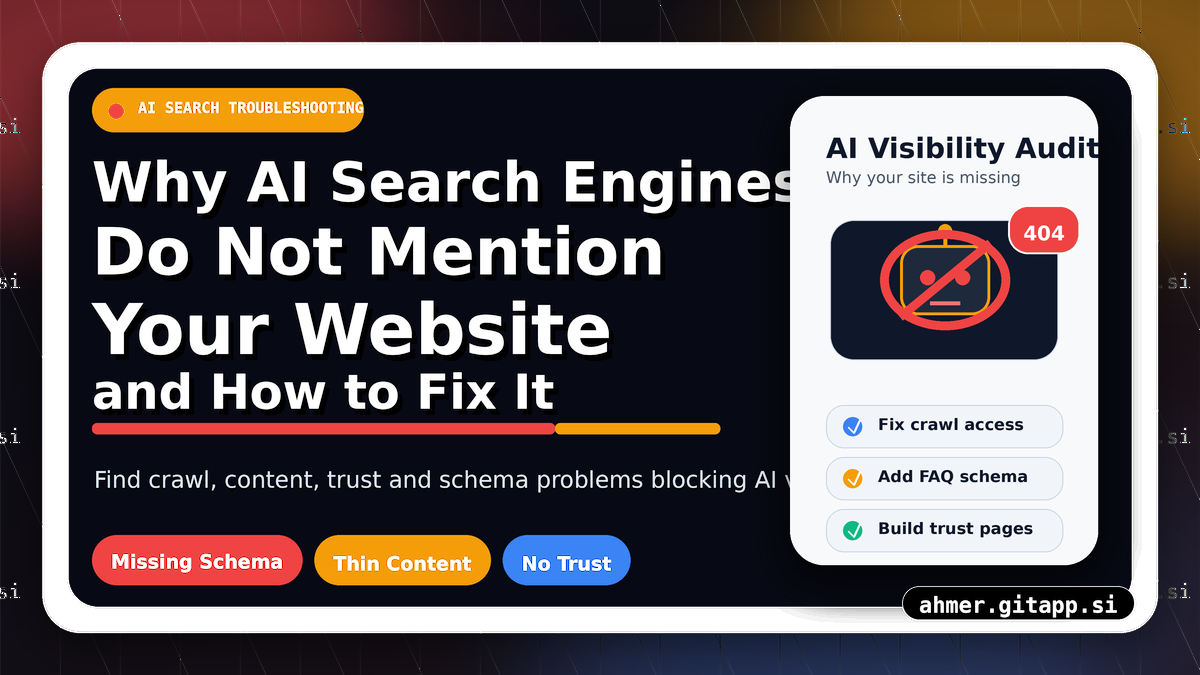
- Why AI Search Engines Do Not Mention Your Website and How to Fix It. Slug: why-ai-search-engines-do-not-mention-your-website.
🏁 Final Thoughts.
AI citations are becoming a powerful part of modern SEO because users are getting more answers directly from AI platforms. If your website is cited by AI search tools, it can gain trust, visibility, and possible referral traffic.
To improve AI citations, focus on source-quality content. Give direct answers, add original value, use structured tables, answer real questions, show trust signals, and make your pages easy to crawl. The goal is not just to publish content, but to become the source AI tools can confidently reference.
❓ Frequently Asked Questions.
What is an AI citation?
An AI citation is when an AI search tool uses your website as a source for an answer. It may appear as a source link, reference card, or cited website name.
Are AI citations different from backlinks?
Yes. A backlink is a link from one website to another website. An AI citation is a source reference inside an AI-generated answer. Both can support visibility, but they work differently.
Which AI platforms show citations?
Platforms such as Perplexity and Google AI Overviews often show sources. ChatGPT may show sources depending on the mode, query, and browsing or search features available.
How do I make my website citation-ready?
Make your content clear, helpful, structured, updated, and trustworthy. Use direct answers, tables, FAQs, schema markup, internal links, author details, and crawlable pages.
Can schema markup guarantee AI citations?
No. Schema markup does not guarantee AI citations, but it helps AI and search systems understand your page better. It should be used with strong content and trust signals.
Why does AI cite competitors instead of my website?
AI may cite competitors if their content is clearer, more trusted, more detailed, better structured, or easier to access. Improve your content quality, crawlability, topical coverage, and authority signals.

I am Kashi Ahmer, founder of Ahmer.gitapp.si. I share simple guides and tools about AI Visibility Checker, SEO, AEO, GEO, schema markup, AI citations, and AI search optimization to help users improve their website visibility in search engines and AI platforms. For feedback or questions, contact me at ahmer@gitapp.si.
Related Posts
Leave a Comment
No comments yet — be the first to comment!